
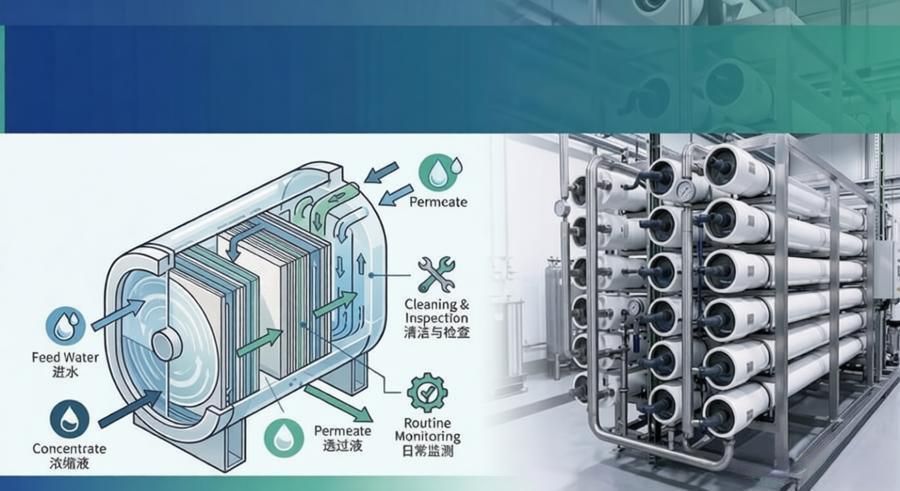
Maintenance & FAQ for DTRO Membrane Modules
Maintenance & FAQ for DTRO Membrane Modules
1. Daily Maintenance and Operation
To ensure the long-term stable operation of Disc-Tube Reverse Osmosis (DTRO) modules and extend the service life of the membrane plates, the following daily routines are essential:
- Pre-treatment Monitoring: Regularly check the Silt Density Index (SDI) and turbidity of the feed water. Ensure the filtration system is working correctly to prevent suspended solids from entering the membrane stack.
- Operating Parameters: Keep a daily log of feed pressure, permeate flow, and concentrate flow. A sudden drop in permeate flow usually indicates the need for cleaning. Learn more about operating parameters.
- System Flushing: Every time the system stops, initiate an automatic low-pressure flush using permeate to remove highly concentrated salts from the membrane surfaces. Find details on system flushing.
2. Cleaning Strategies (CIP)
Chemical-in-Place (CIP) cleaning should be performed when the system performance deviates from the baseline (e.g., a 15% increase in pressure or a 10-15% decrease in flow).
- Acidic Cleaning: Used to remove inorganic scaling such as calcium carbonate or metal oxides.
- Alkaline Cleaning: Used to remove organic fouling, biological films, and oil residues.
- Frequency: The cleaning cycle depends on the raw water quality (e.g., landfill leachate), but typically ranges from weekly to monthly. Visit our guide on cleaning frequency for more information.
3. Frequently Asked Questions (FAQ)
Q: Why is the permeate conductivity higher than usual?A: This is often caused by damaged O-rings or seals within the membrane stack, allowing feed water to bypass the membrane. It could also indicate membrane degradation due to chemical exposure or aging.
Q: What is the typical lifespan of a DTRO membrane?A: Under standard operating conditions with proper pre-treatment and regular CIP, DTRO membranes generally last between 1 to 3 years.
Q: How should I store the modules during a long-term shutdown?A: For shutdowns exceeding 48 hours, the system must be flushed and filled with a preservative solution (typically 1% sodium bisulfite) to prevent bacterial growth and membrane drying.
Q: Why has the operating pressure increased significantly?A: High pressure is usually a sign of membrane scaling or a blockage in the feed channels. Perform a CIP sequence immediately to prevent irreversible damage to the membrane discs.